
IR vs ToF Sensor Faucets
Which sensing technology performs better in high-traffic restrooms? The practical answer is not just about “newer” versus “older.” It depends on traffic volume, basin geometry, lighting, maintenance access, power design, and how reliably the faucet detects hands without wasting water.
Fast Verdict
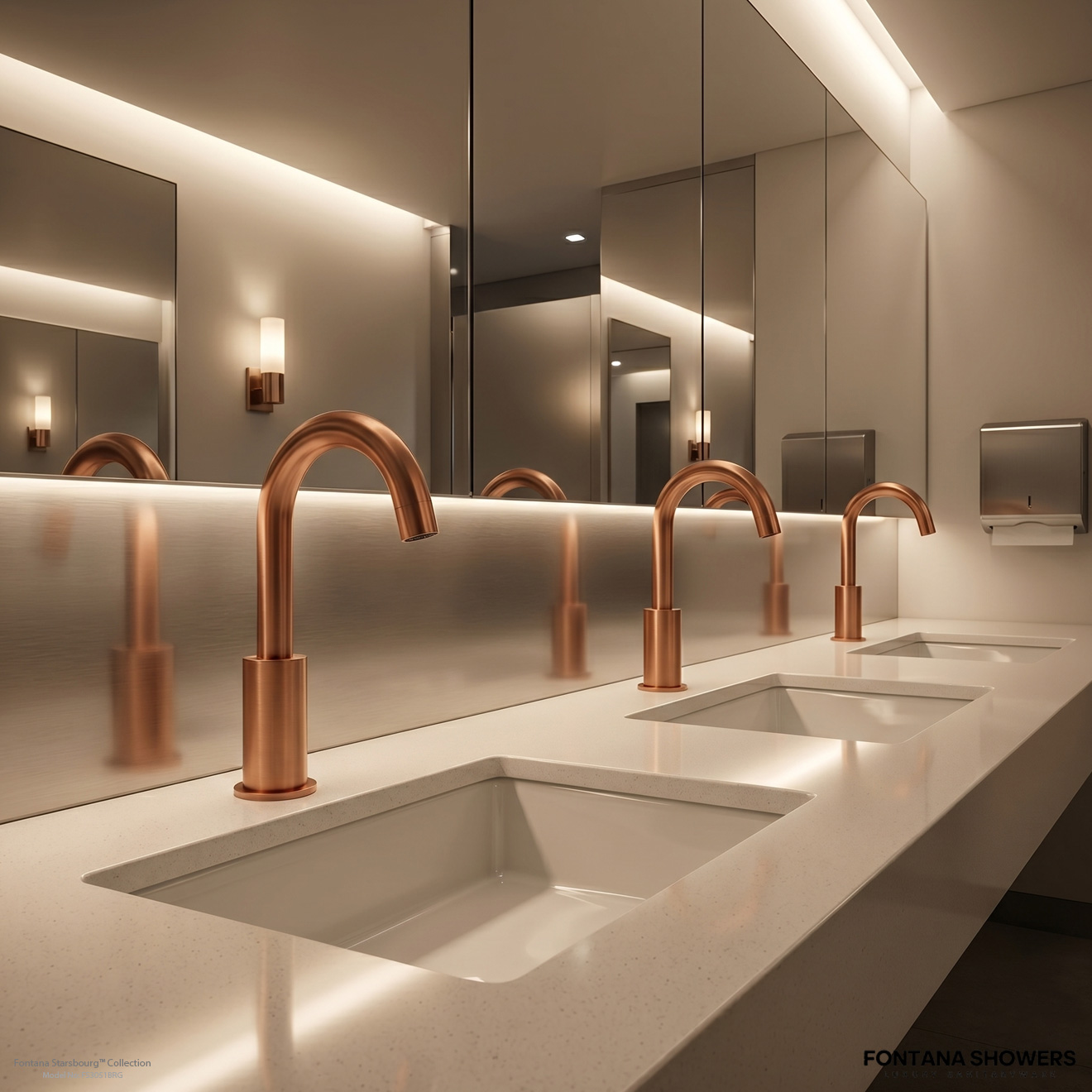
Infrared sensor faucets are still the safer default for most high-traffic commercial restrooms because the technology is widely available, well understood by maintenance teams, easy to specify, and supported by many commercial faucet manufacturers.
Time-of-Flight sensor faucets are stronger in complex detection conditions where the system needs more precise distance reading, better separation between hands and background surfaces, or more stable performance around dark finishes, reflective bowls, unusual sink geometry, or changing light.
The best choice is not simply “IR or ToF.” For airports, stadiums, schools, offices, hospitals, restaurants, and transit facilities, the better question is: which sensor gives the lowest false activation rate with the least maintenance burden in this exact sink layout?
Why This Matters
A sensor faucet in a quiet office restroom may activate a few dozen times per day. A faucet in a stadium, airport, school, clinic, or busy restaurant can cycle hundreds or thousands of times. At that level, small sensor problems become visible quickly.
Poor sensing can create three costly problems: users wave their hands repeatedly, water runs when nobody is washing, or facility teams keep returning to adjust sensors and replace batteries. In high-traffic restrooms, the sensing method affects user experience, water use, janitorial workload, and long-term maintenance planning.
Start Fast
Hands should trigger water quickly without awkward waving, double attempts, or contact with the spout.
Stop Cleanly
The faucet should shut off when hands leave the zone, not after long delays or false object detection.
Stay Stable
Once installed, the faucet should keep its sensing behavior despite lighting changes, cleaning routines, and heavy use.
How IR Works
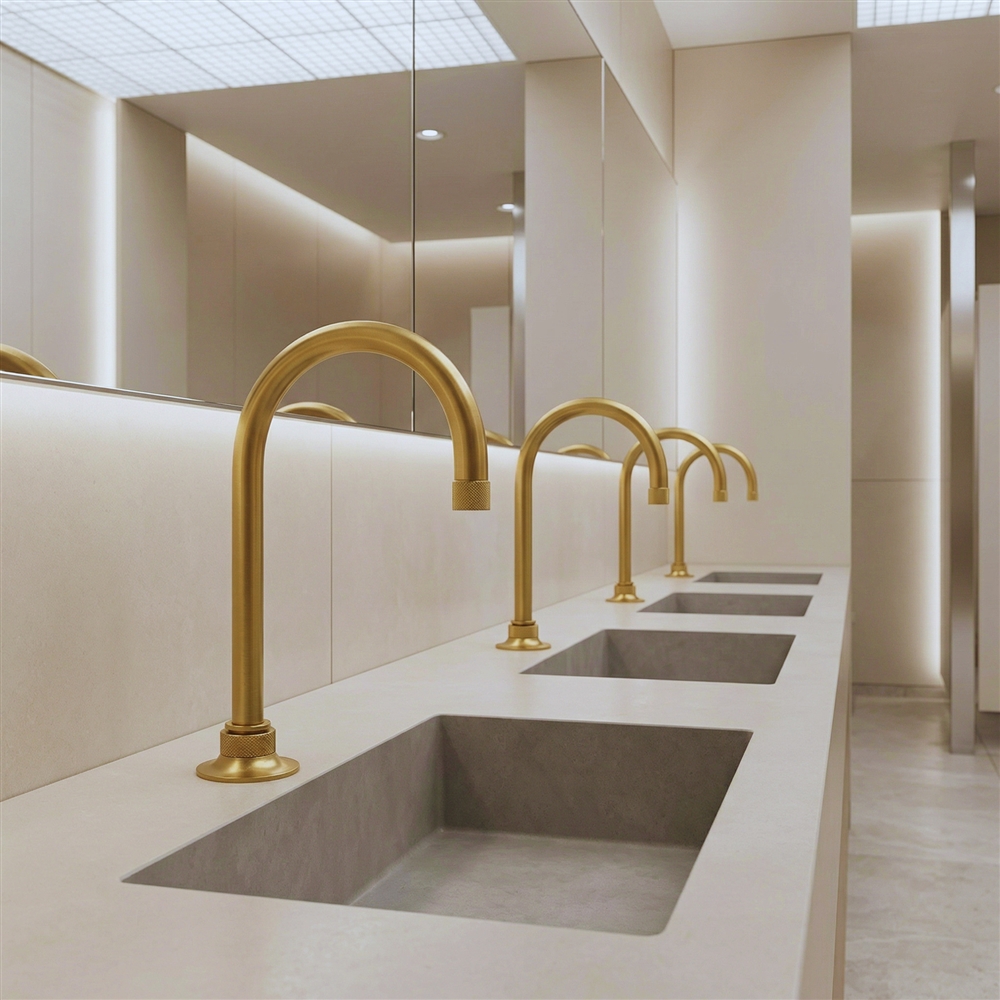
Infrared, often called IR, is the most common detection method in commercial automatic faucets. In a typical active IR faucet, the sensor emits infrared light toward the hand-washing area. When hands enter the detection zone, reflected infrared light returns to the receiver. The control electronics then open the solenoid or valve.
IR has earned its place in commercial restrooms because it is compact, cost-effective, familiar to installers, and available across many faucet styles. It works well when the sensor window is clean, the detection zone is properly aimed, the sink finish is not confusing the sensor, and the environment is reasonably controlled.
Where IR Performs Well
- Standard lavatory decks with predictable user hand position.
- Restrooms where parts availability and quick repair are top priorities.
- Projects needing a proven, budget-aware specification.
- Schools, offices, retail restrooms, and common commercial washrooms.
How ToF Works
Time-of-Flight, or ToF, also uses light, often near-infrared light. The difference is in how distance is calculated. Instead of mainly judging the strength of reflected light, a ToF system measures how long emitted light takes to travel to the object and return to the sensor.
This gives the sensor a more direct distance reading. In restroom terms, ToF can help the control system understand whether the object in front of the faucet is actually a user’s hands, a reflective sink wall, a dark sleeve, a shiny basin surface, or background movement outside the intended wash zone.
ToF is especially interesting for next-generation commercial fixtures because it can support tighter activation zones, more advanced filtering, and stronger resistance to some reflectance-related issues that affect basic optical sensors.
Technical Comparison
The table below compares the two technologies from a specifier’s point of view. Scores are practical guidance, not lab certification. Always verify the actual faucet model, sensor range, power source, cleaning instructions, and manufacturer support before writing a final project specification.
| Category | IR Sensor Faucet | ToF Sensor Faucet | Specifier Note |
|---|---|---|---|
| Market availability | 5/5 Very common across commercial faucet lines. |
3/5 Growing, but less common in standard plumbing catalogs. |
IR is easier to source for large projects and replacements. |
| Detection precision | 3/5 Good when aimed and calibrated correctly. |
5/5 Stronger distance awareness and target separation. |
ToF can be better when sink geometry is difficult. |
| False activation control | 3/5 Can be affected by reflection, sensor window dirt, and basin layout. |
4/5 Can filter background distance more effectively when engineered well. |
Actual performance depends on firmware and fixture design. |
| Maintenance familiarity | 5/5 Most facility teams already know the service routine. |
3/5 May require more manufacturer-specific support. |
For schools and public agencies, technician familiarity matters. |
| Cost control | 5/5 Strong option for budget-sensitive rollouts. |
3/5 May cost more depending on sensor module and control design. |
ToF should justify its premium with lower nuisance issues. |
| Best use case | Reliable standard commercial restrooms. | Complex, reflective, premium, or data-driven restrooms. | Match sensor type to risk, not trend. |
Specifier Score Chart
Relative planning score for high-traffic restroom projects. Higher is better.
High-Traffic Cases
Different restroom types create different sensing risks. A stadium restroom has rush periods, rough use, and fast cleaning cycles. An airport restroom has luggage, reflective surfaces, wide user variation, and long operating hours. A hospital restroom may prioritize hygiene, accessibility, and predictable operation for patients and staff.
Mixed Users
Travelers approach faucets from different angles with bags, coats, and rolling luggage. ToF may help when geometry and reflections confuse basic sensing, but IR remains easier to maintain across large fixture counts.
Rush Cycles
During halftime or event breaks, faucets must activate quickly and shut off cleanly. IR is usually the practical choice because parts, service, and cost control matter at scale.
Hygiene Priority
Hands-free operation supports a cleaner user path. ToF may be useful where precise activation reduces user frustration, but the full fixture must still support infection-control cleaning routines.
Durability First
Schools need vandal resistance, predictable battery access, and simple service. IR sensor faucets are often the better default unless the sink layout has a known detection issue.
When IR Wins
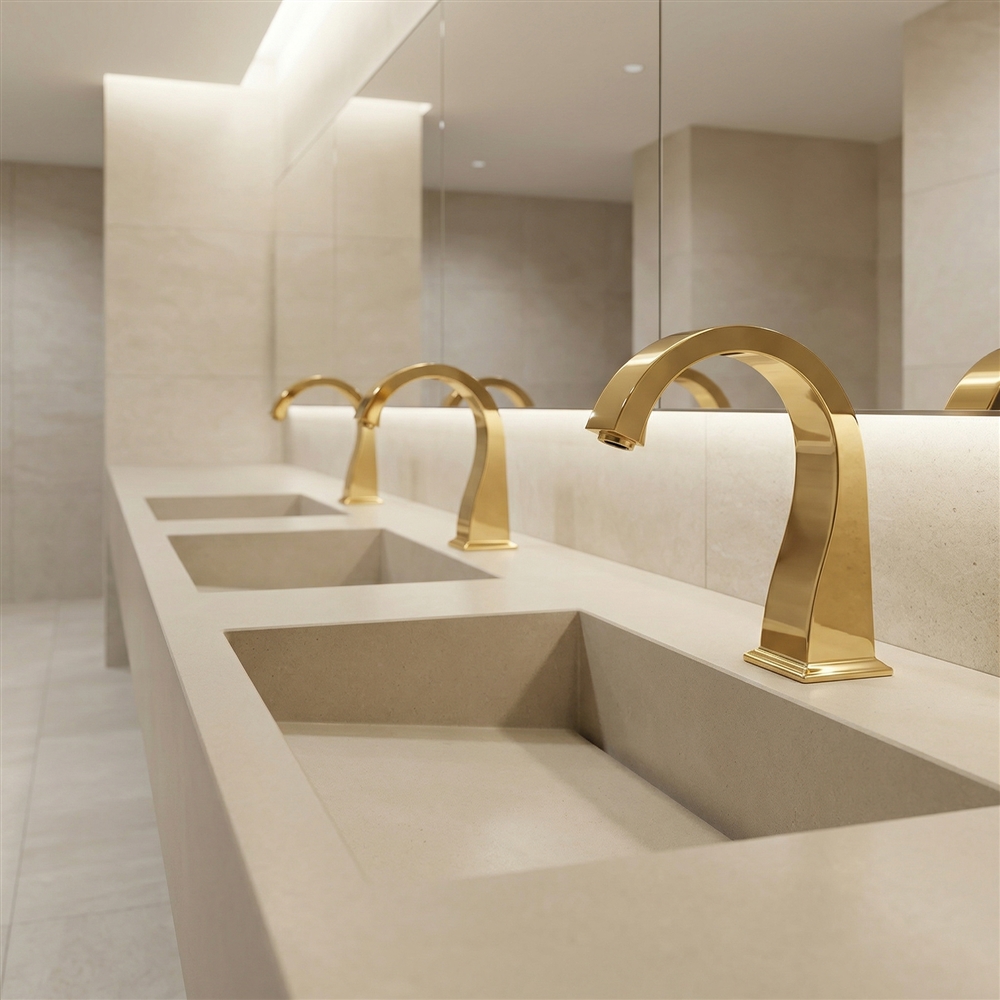
Choose IR when the project needs a proven, easily supported, cost-controlled faucet system. For most public restrooms, especially those with standard lavatories and predictable sink layouts, IR is the most practical specification.
- Large fixture counts: IR usually provides better procurement flexibility across dozens or hundreds of faucets.
- Simple maintenance: Facility teams are more likely to have experience with IR troubleshooting, battery changes, and sensor cleaning.
- Standard sinks: If the basin, spout reach, and hand-washing zone are conventional, IR detection is usually reliable.
- Budget control: IR is often easier to align with value-engineering needs without removing touchless operation.
When ToF Wins
Choose ToF when the restroom design creates a real sensing challenge or when a premium project needs tighter activation behavior. ToF has a technical advantage because it can measure distance more directly instead of relying mainly on reflected signal strength.
- Reflective basins: Polished bowls, glossy counters, and unusual surfaces can create optical confusion.
- Dark targets: Some optical systems struggle with dark sleeves, gloves, or low-reflectance objects.
- Tight zones: ToF can support more controlled activation areas when engineered into the faucet correctly.
- Premium restrooms: Airports, luxury hospitality, healthcare, and smart-building projects may justify added sensor capability.
Important Specification Note
Do not specify ToF by sensor chip alone. A faucet’s real-world performance depends on the complete system: sensor placement, firmware, lens cover, water stream location, solenoid response, power source, basin shape, and cleaning access.
Flow, Codes, and Access
Sensor technology is only one part of a high-performing restroom faucet. The faucet also needs the right flow rate, water temperature strategy, accessibility alignment, and tested plumbing standard compliance.
Match the Use
Public lavatory faucets often use low-flow outlets such as 0.5 gpm, depending on local code and project goals. Verify the actual aerator, laminar outlet, pressure range, and hand-washing performance.
Keep Reach Clear
The faucet, sink, and counter should work together so users can reach the water stream comfortably without tight grasping, pinching, twisting, or awkward body position.
Verify Listing
For commercial plumbing specifications, confirm applicable listings such as ASME A112.18.1/CSA B125.1, local plumbing code requirements, lead-free rules, and project-specific owner standards.
Specifier Checklist
Before choosing IR or ToF, test the sensing problem the restroom actually has. A clean specification should describe performance expectations, not just the word “touchless.”
| Checklist Item | What to Confirm | Why It Matters |
|---|---|---|
| Sensor range | Factory range, adjustable range, and field calibration method. | Prevents short activation, long activation, or sink-surface triggers. |
| Sink geometry | Spout reach, stream landing point, basin depth, backsplash, and finish. | The best sensor can still fail in a poor sink-and-spout layout. |
| Power source | Battery, hardwired, plug-in, solar assist, hydropower, or hybrid design. | High-traffic restrooms punish weak power planning. |
| Timeout setting | Maximum run time and automatic shutoff behavior. | Controls waste if a bag, reflection, or object remains in the zone. |
| Service access | Above-deck access, battery drawer, control box location, and solenoid replacement path. | Maintenance time affects real operating cost. |
| Cleaning routine | Approved cleaners, sensor window care, and lens cover durability. | Chemical haze or grime can reduce sensor reliability. |
Best Overall Choice
For most high-traffic public restrooms, IR sensor faucets are the best overall choice today. They are proven, widely available, easier to repair, and simpler to standardize across a facility portfolio.
ToF is the better performance choice when detection precision is the main problem. If a restroom has reflective counters, dark finishes, unusual basin geometry, premium user-experience goals, or persistent false activations, ToF deserves serious consideration.
The strongest specification is performance-based: require fast activation, clean shutoff, stable sensing after cleaning, accessible reach, appropriate flow rate, listed plumbing compliance, and easy service access. Then select the sensor technology that proves it can meet those conditions in the actual restroom layout.
FAQ
Are ToF sensor faucets always better than infrared faucets?
No. ToF can offer stronger distance detection, but IR is often the better practical choice because it is widely available, familiar to maintenance teams, and cost-effective for large commercial projects.
Why do some sensor faucets turn on by themselves?
False activation can be caused by reflections, poor sensor aiming, dirty sensor windows, nearby objects, glossy basin surfaces, low battery voltage, or an activation zone that is too wide for the sink design.
Which sensor is better for airports and stadiums?
IR is usually the safer default for large fixture counts because it is easier to source and service. ToF may be better in premium or difficult installations where false triggers or missed detections are already a known issue.
Does sensor type affect water savings?
Yes, indirectly. The sensor controls when water starts and stops. A stable sensor reduces wasted run time, but the final water use also depends on flow rate, timeout, aerator type, pressure, and user behavior.
What should be specified besides the sensor?
Specify flow rate, power source, timeout, vandal resistance, lead-free compliance, ADA installation requirements, service access, compatible mixing valve strategy, and applicable plumbing standards.
Reference Sources
The following references support the technical and specification points in this guide. Source buttons open in a new tab.
Comparing Infrared and Time-of-Flight Sensing Technologies for Commercial Faucets
Modern commercial touchless faucets primarily rely on two sensing technologies: traditional Infrared (IR) sensors and the newer Time-of-Flight (ToF) sensing systems. While both are designed to provide reliable hands-free operation, they differ in detection accuracy, environmental performance, response consistency, and long-term reliability. Architects, mechanical engineers, plumbing designers, facility managers, and specification writers increasingly evaluate sensor technology because it directly affects restroom performance, user experience, maintenance requirements, and lifecycle operating costs.
Choosing the Right Detection Technology
Infrared sensors detect reflected light from nearby objects and have been widely used in commercial faucets for many years. Time-of-Flight sensors operate differently by measuring the travel time of emitted light, allowing the controller to calculate distance more precisely. In busy commercial environments where lighting conditions, reflective surfaces, sink geometry, and user movement vary throughout the day, more accurate distance measurement can improve activation consistency and reduce unintended triggering.
The best sensor choice depends on project requirements, expected traffic levels, installation conditions, and the desired balance between performance, maintenance simplicity, and overall system cost.
Selecting Sensor Technology for Long-Term Facility Performance
For airports, healthcare facilities, hospitality properties, universities, government buildings, and office complexes, sensor performance influences more than user convenience. Reliable activation reduces unnecessary maintenance requests, minimizes water waste caused by false triggering, and improves overall restroom efficiency. Evaluating sensing technology alongside faucet construction, electronics, service accessibility, and replacement part availability helps create a more dependable commercial restroom system.
As commercial sensor technology continues to evolve, many specification teams compare both IR and ToF solutions to determine which best aligns with the operational requirements of each individual project.
Related Commercial Sensor Technology Resources
-
Commercial Sensor Technology Guide
Learn how modern sensing technologies support dependable activation, water efficiency, and long-term commercial restroom performance. -
Commercial Touchless Bathroom Faucets
Explore commercial touchless faucet systems designed for airports, healthcare, hospitality, education, office buildings, and public infrastructure. -
Quality & Durability Guide
Review engineering quality, construction methods, finish durability, and lifecycle considerations for commercial touchless faucets. -
Power Source Planning
Compare battery-powered, AC-powered, and hybrid touchless faucet systems for commercial building applications. -
Top-Rated Commercial Touchless Faucets
Compare commercial faucet collections recognized for dependable sensor performance, durable construction, and long-term facility reliability.