Top 10 Toptouchlessfaucets Mistakes to Avoid
A Technical Guide for Architects, MEP Engineers, Plumbing Contractors, and Facility Managers
Touchless faucets have become an increasingly important component of commercial restroom design, supporting hands-free operation, controlled water delivery, and modern building performance objectives. However, specifying an automatic faucet without evaluating its complete operating system can introduce installation complications, inconsistent sensor response, unnecessary water consumption, and costly maintenance.
For architects, engineers, and construction professionals, successful commercial touchless faucet specification requires coordination between sensor technology, hydraulic performance, electrical infrastructure, accessibility, and long-term facility operations.
The following ten mistakes highlight critical considerations for designing reliable, code-conscious, and maintainable sensor-operated plumbing systems.


Ignoring Sensor Detection Performance
One of the most common specification mistakes is assuming that all infrared and electronic sensing technologies perform identically.
Infrared (IR) sensors and time-of-flight (ToF) systems can differ in detection geometry, reflectivity sensitivity, operating range, and response characteristics.
Read More Read Less
Highly reflective basins, ambient lighting, backsplash materials, and hand positioning can affect activation reliability.
AEC Recommendation: Evaluate the detection field against actual lavatory geometry and verify sensor calibration during commissioning. A product’s published detection range does not guarantee equivalent performance in every installation.
Selecting Incorrect Faucet Flow Rates
Flow-rate selection directly influences water consumption, user comfort, and regulatory compliance.
The U.S. Environmental Protection Agency’s bathroom faucet guidance distinguishes public lavatories from private bathroom fixtures.
Read More Read Less
Public lavatory faucets typically require a maximum flow rate of 0.5 gallons per minute (GPM) under applicable U.S. plumbing requirements, while WaterSense-labeled private lavatory faucets have a maximum of 1.5 GPM.
Specifying residential flow rates for public restrooms can create code and efficiency problems.
AEC Recommendation: Confirm public versus private fixture classification, operating pressure, and applicable plumbing code before selecting a commercial sensor faucet.
Overlooking Basin and Spout Coordination
Even a technically advanced faucet can perform poorly when improperly matched with its basin.
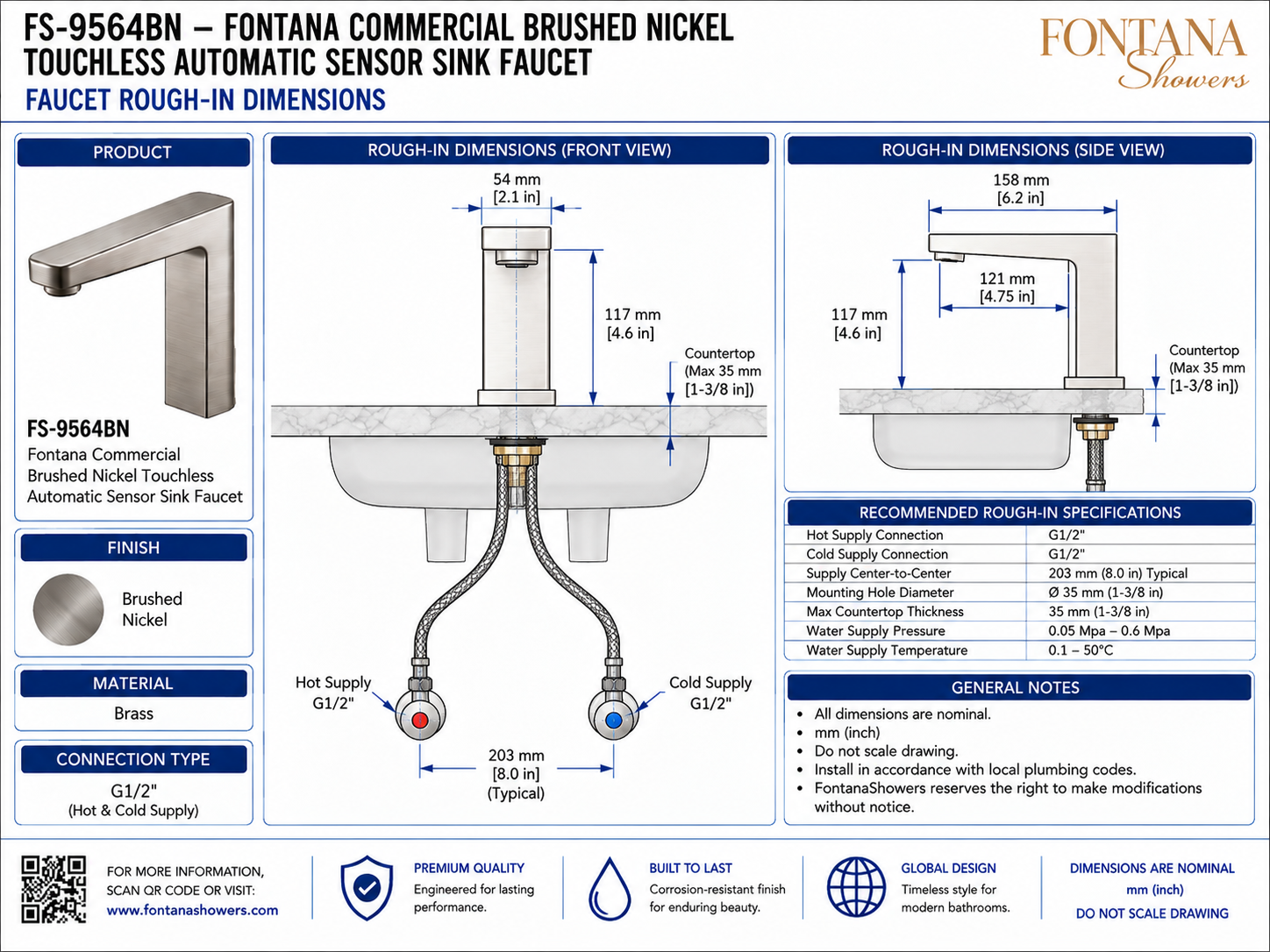
Spout projection, outlet angle, bowl depth, drain position, and backsplash clearance influence splash behavior and user accessibility.
Read More Read Less
An outlet discharging directly onto a shallow drain assembly may produce excessive splashing.
AEC Recommendation: Coordinate faucet and lavatory shop drawings before procurement. Evaluate water discharge location, sensor detection geometry, and basin dimensions through a representative mockup.

Neglecting Water Pressure Requirements
Electronic faucets rely on predictable hydraulic conditions for reliable water delivery.
Pressure fluctuations, clogged strainers, undersized supply lines, and unsuitable flow-control devices can cause weak discharge or inconsistent operation.
Read More Read Less
Solenoid valves also have manufacturer-specific operating pressure limits.
AEC Recommendation: Verify minimum and maximum operating pressures, available dynamic pressure, and the complete flow path. Include strainer inspection and flow verification in the plumbing commissioning procedure.

Improper Temperature Mixing Design
Many sensor faucets rely on separate mixing devices or centrally tempered water rather than integrated temperature controls.
Failing to coordinate these components can produce uncomfortable or potentially hazardous discharge temperatures.
Read More Read Less
Relevant safeguards may include appropriately selected ASSE 1070-compliant temperature-limiting devices, depending on the application and governing code.
AEC Recommendation: Document the mixing arrangement, maximum delivered temperature, adjustment method, and maintenance access. Verify compatibility with the building’s domestic hot-water system.

Choosing the Wrong Power Configuration
Battery-powered, transformer-fed, hardwired, and hybrid sensor faucets each introduce different installation and maintenance requirements.
Battery systems may simplify retrofit construction but require periodic replacement. Hardwired configurations introduce electrical coordination, accessible transformer placement, and outage considerations.
Read More Read Less
Neither arrangement is universally superior.
AEC Recommendation: Compare electrical rough-in requirements, anticipated activation frequency, replacement intervals, service accessibility, and failure behavior before finalizing the fixture schedule.
For broader system planning, consult the commercial touchless faucet brand comparison guide .

Assuming Touchless Means ADA Compliant
Automatic operation can improve accessibility, but a hands-free sensor does not independently establish compliance with the Americans with Disabilities Act.
The 2010 ADA Standards for Accessible Design address clear floor space, lavatory mounting height, operable controls, knee clearance, and exposed piping protection.
Read More Read Less
For accessible lavatories, the standard generally limits the rim or counter height to 34 inches above the finished floor, subject to specified exceptions.
AEC Recommendation: Evaluate the complete accessible lavatory assembly, including sensor activation from a seated position.

Accepting Unverified Product Certifications
Marketing language such as lead-free, commercial grade, or code compliant should never replace technical documentation.
Specifications should address ASME A112.18.1/CSA B125.1 for plumbing supply fittings, NSF/ANSI/CAN 61 for drinking-water health effects, and NSF/ANSI/CAN 372 for lead-content verification where applicable.
Read More Read Less
AEC Recommendation: Require current certification records matching the exact submitted fixture and applicable wetted components.
The NSF/ANSI 61 and lead-free touchless faucet guide provides additional specification context.
Ignoring Water Quality and Stagnation
Touchless activation reduces contact with faucet controls, but it does not automatically eliminate microbial risks within the water system.
Internal solenoid assemblies, flexible connectors, low-use branches, and stagnant water can create additional water-quality management considerations.
Read More Read Less
ASHRAE Standard 188 provides a framework for managing Legionella risks in applicable building water systems.
AEC Recommendation: Coordinate sensor faucet selection with the facility water management program, flushing procedures, temperature control, and maintenance strategy.
Healthcare projects require particular attention to internal waterway design and contamination risk.

Skipping Commissioning and Maintenance Planning
A correctly specified faucet can still generate operational problems when its control system is not properly commissioned.
Unverified sensing ranges, delayed shutoff, inaccessible strainers, missing replacement components, and undocumented control settings increase maintenance complexity.
Read More Read Less
AEC Recommendation: Establish an acceptance procedure covering activation, shutoff response, delivered temperature, flow measurement, splash containment, leakage, cleaning mode, and service access.
Facility teams should receive final settings, technical documentation, replacement-part identification, and inspection procedures.
Technical Chart: Faucet Runtime and Water Demand
The following model illustrates how operating duration affects annual water use in a high-traffic commercial restroom system.
Assumptions: 25 faucets, 80 activations per faucet per operating day, 260 days annually, and a constant 0.5 GPM discharge.
Annual Water Demand
Runtime Comparison
| Average Active Flow | Annual Water Use | Reduction vs. 20 Seconds |
|---|---|---|
| 20 seconds | 86,667 gallons | Baseline |
| 15 seconds | 65,000 gallons | 25% |
| 10 seconds | 43,333 gallons | 50% |
Read More Read Less
Calculation: Annual gallons = faucet quantity × daily activations × operating days × (active-flow seconds ÷ 60) × GPM.
These are illustrative engineering calculations, not measured project savings. Active-flow time must support effective handwashing; a ten-second modeled flow period is not a recommendation to shorten the required soap-scrubbing process.
Design teams can explore additional modeling considerations in the LEED and WELL touchless restroom water-efficiency guide .

Research Case: Healthcare Faucet Performance
A 2015 multi-hospital investigation published in Infection Control & Hospital Epidemiology evaluated 105 electronic faucets, 90 manual faucets, and 14 foot-operated faucets across four healthcare centers in Quebec.
Read More Read Less
Researchers found that contamination patterns varied according to faucet architecture, connecting-pipe materials, and water-quality conditions. Certain electronic faucet configurations exhibited higher Pseudomonas aeruginosa prevalence than others.
The findings demonstrate that electronic activation alone cannot establish water-hygiene superiority.
For healthcare design teams, the practical implication is clear: assess wetted components, internal water volume, stagnation conditions, and water-management compatibility alongside the benefits of reduced touch contact.
Conclusion: Engineering Beyond Automation
The most effective touchless faucet installations result from coordinated engineering rather than appearance-driven procurement.
Read More Read Less
Architects should evaluate lavatory geometry and accessibility; MEP engineers should verify hydraulic performance, temperature control, and power infrastructure; contractors should confirm installation tolerances; and facility managers should establish maintainable operating procedures.
By avoiding these ten mistakes, project teams can reduce commissioning uncertainty, strengthen specification quality, and improve long-term restroom performance.
For additional AEC technical guidance, explore the Top Touchless Faucets technical knowledge hub , covering sensor architecture, commercial faucet specifications, water efficiency, accessibility, and lifecycle maintenance.